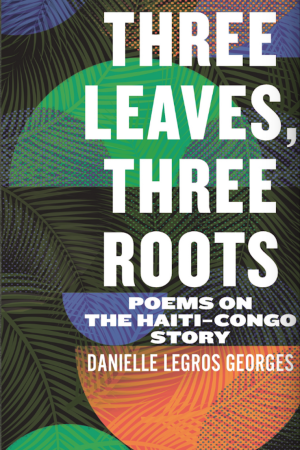
Three Leaves, Three Roots
“
Three Leaves, Three Roots is a captivating collection of poems that vividly portrays the journeys of Haitian professionals, including Danielle Legros Georges’s parents, who traveled to the Congo in the 1960s to support the decolonization movement. Through beautiful and captivating language, Georges intertwines personal narratives and letters, crafting a compelling testimony to a pivotal yet often overlooked moment in history. This profound exploration of migration and solidarity pays tribute to the lives of those we encounter within its pages while illuminating Haiti’s potential as a symbol of global liberty.
Edwidge Danticat
As the poet moves us through landscapes lost, discovered, and found again, from Port-au-Prince, Kinshasa, to the banks of the Rio Grande, we discover voices displaced, exiled, and scorned, with love for their shared African roots even as these move from one geography to another. Sweeping in its breadth and historical coverage, Three Leaves, Three Roots is a triumph of poetic quietude in the midst of the chaos that surrounds depictions of Haiti today.
Myriam J. A. Chancy
As the poet tells us in her introduction, Three Leaves, Three Roots is an act of reclaiming the "little known" story of Haitians, including her parents, who traveled to the Congo in the 1960s to work and live. Legros Georges’s opus is impressive in its scope, and one can sense the research undergirding every word. But make no mistake: this is a poet’s reckoning with history. Legros Georges’s language is chiseled and sonically rich, her poetics potent and dazzling. In epistolary poems and dramatic monologues drawn from interviews and other source materials, she delivers a powerful melding of personal and public testimony. Three Leaves, Three Roots is a searing work of documentary and lyric poetry.
Shara McCallum
A brilliant achievement. Danielle Legros Georges’s Three Leaves, Three Roots makes a compelling case for the role of poet as custodian of what once was lost and now is found. In these times of voluntary and forced migrations, these poems are shining testaments and urgent exposés of historical injustice and tender lyrics. This collection places this poet where she belongs, in the front ranks of poets writing today.
Lorna Goodison
Crafted in a poetic gift full of compassion, Three Leaves, Three Roots should be seen as a welcome addition to the axis being formed in this, our time of resurrection and change like none other. Georges’s work is an elegant brilliance, nurtured in silent meditations on courage in a life lived deep inside the heart of Blackness.
Afaa M. Weaver
Acts of resistance: a chapbook
“
Acts of Resistance to New England Slavery by Africans Themselves in New England is a powerful and lyrical reckoning with the often overlooked narratives of Black resistance in the North. Through a series of searing, evocative poems, Legros Georges breathes life into historical figures like Elizabeth Freeman, Crispus Attucks, and Phillis Wheatley, illuminating their acts of defiance, self-making, and self-liberation. The collection reclaims the stories of those who resisted through legal battles, rebellion, survival, and sheer will, transforming archival records into haunting and necessary verse.
Patrick Sylvain
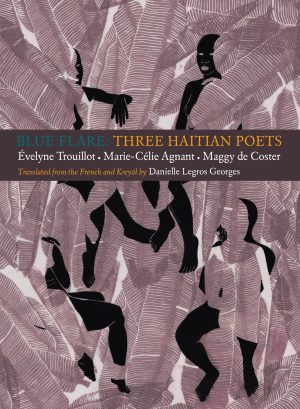
blue flare: three haitian poets
“
Blue Flare: Three Haitian Poets represents the first English translations of selected works by three celebrated writers who confront and contend with the complexity of life in Haiti and its diaspora in the 21st century. Writing from the standpoints of, and attending to, the lived experiences of women, Évelyne Trouillot, Marie-Célie Agnant, and Maggy de Coster present readers with texts that reveal and dream, that instigate interrogations, that move beyond the ground of the nationalistic, that express deep commitments to questions of ethics, that mine intersections and occupy crossroads.
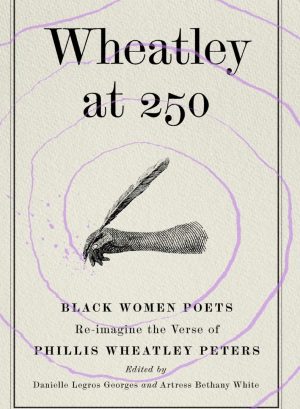
Wheatley at 250
“
This book is a treasure! Wheatley at 250: Black Women Poets Re-imagine the Verse of Phillis Wheatley Peters is a blessing and a balm. I am deeply moved by the experience of reading twenty marvelous poems by the great Phillis Wheatley alongside an equal number of thrilling reinscriptions by some of today’s most miraculous writers.
Camille Dungy
During America’s turbulent generation, Phillis Wheatley Peters made the revolutionary and merciful act of seeing herself as a poet, writing herself into her present—and therefore, our nation’s future. Her lasting influence is generative. This extraordinary anthology ... asks us to approach Wheatley’s work in conversation with a group of our nation’s most ambitious poets, inviting us, her readers, into active interpretation, feeling her reach beyond the limits of a page, but into life, like a permanent flowering.
Ricardo Alberto Maldonado
Island Heart
“
A beautifully translated work of poignant, lyrical poems by Ida Faubert that evoke the beauty, power and mystery of nature. This collection of poems reflects the intricate web of the human experience of love, loss and longing.
M. A. Salvadon
Reading the poetry of Ida Faubert, one is quickly struck by her ability to gracefully plot an emotionally-charged and layered interior landscape, ranging from the rawness of passion’s lost love to the tender, severed bonds of motherhood. In the beauty of her formal phrasing resides a poet’s desire to record life’s ever-evolving and nuanced lessons. Kudos to Danielle Legros Georges for a deft translation of this body of work by the lauded Haitian poet.
Artress Bethany White
the dear remote nearness of you
“
The Dear Remote Nearness of You will both move your heart and rattle you to the core. These lyrical, poignant, and powerful poems show Danielle Legros Georges’ deep intellect and profound empathy, as well as her endless gifts as a poet, storyteller, and brilliant oracle of the human spirit.
Edwidge Danticat
The Dear Remote Nearness of You speaks poetry’s origin in new and startling ways. This is the precise intelligence that knows it must step carefully across the light on the surface of the water… These poems form the contiguous dance of language choosing its own body at will, traveling across light and the dimensions of unarticulated history. This is the word rubbed onto the palimpsest of our being, the careful solo soprano in the space where music ends and poetry moves in to name what is eternal and what is only in the abbreviation of now. What a delightful book…
Afaa Michael Weaver
Sublime, by which I mean these poems present a world not merely beautiful, but so charged with life as to induce wonder. Desire, in all her manifestations (spells, curses, jealousy, want), runs through these pages.
Nick Flynn
Danielle Legros Georges gives us access to worlds that are both submerged and emerging. Whether her poems’ speakers contemplate centenarian eels, or seek to shift the rubble left by Haiti’s devastating 2010 earthquake, The Dear Remote Nearness of You takes careful account of the cost of survival. The atmospheric quality of these poems is dense with attention to the sounds of an inhabitable life: the shock of a shouted racial slur, the high-pitched screech of children, the very sound of the earth splitting. The unsettling intimacies Georges reveals encompass our human relationships with animals, alongside our human understanding of ourselves. Haiti’s own mirrored conversations with itself, through generations of privation and exquisite natural beauty, are the centrepiece of this book’s success.
Shivanee Ramlochan
The Dear Remote Nearness of You reminds us that the poet is a keen observer, a benevolent panoptical being, standing at the crossroads of language and culture with all of her senses open. Georges’s astute panoptical gaze allows us to be in her world, albeit through a remote nearness of her.
Patrick Sylvain
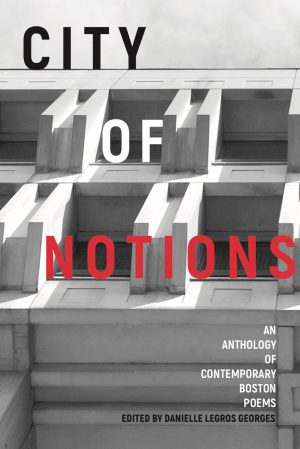
City of Notions
“
A mayor’s greatest privilege and greatest resource is listening to people all across our city, as they share their truths, their hurts, their hopes, and their dreams. City of Notions reflects and enriches that conversation as only art can.
Martin J. Walsh, Mayor of Boston
Letters from Congo: A Chapbook
“
In these 13 intimate and epistolary poems, an address, or a physical location where someone can be reached, swiftly morphs into a statement about the delicate nature of voicing one’s political opinions under Haiti's Duvalier regime. In crafting these necessary poems, Legros Georges compels the reader to abandon notions of romantic and glamorous life in exile, offering instead openings onto the endemic challenges of a family’s confrontations and negotiations of a separation that has no expiration date.

Enzo Silon Surin